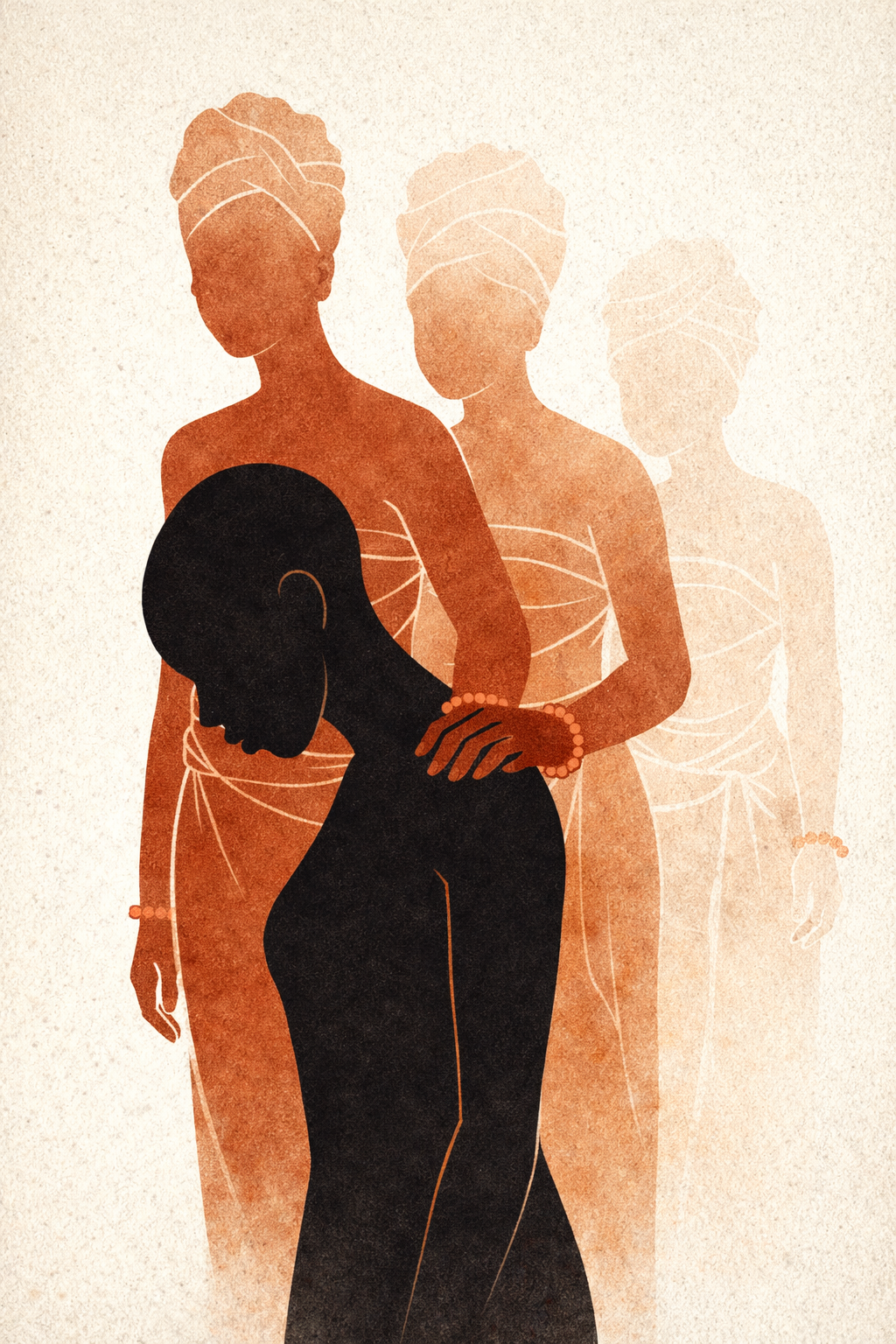

The Weak Link in Your Bloodline: Why Women Inherit Silence- PART I
Bloodline is the oldest contract a woman inherits without signature. It arrives before memory, carried in gestures your grandmother made while cooking, in the silence your mother perfected around certain questions, in the way women in your family learned to make themselves small enough to survive rooms that would not accommodate their actual size. You did not choose this inheritance. You received it the way you received your bone structure and the particular way light catches your skin. The difference is that bone structure does not ask anything of you. Bloodline does.
A bloodline is not your ancestry in the decorative sense, not the stories you tell at dinner parties about where your people came from or what hardships they endured. Those are performances of heritage, ways of making history feel voluntary and meaningful. Bloodline is the residue of decisions made by women whose names you may not remember, choices they made under pressure you cannot imagine, bargains they struck to keep their children fed and their bodies intact. Some of those bargains worked. Others compounded. What you inherited is both the solution and the problem, the survival mechanism that kept the line alive and the limitation that keeps you from living beyond survival.
Women carry bloodline differently than men. A man inherits a name and the option to continue it. A woman inherits a nervous system, a way of breathing in rooms where she is unwelcome, a reflex for reading danger before it announces itself. She inherits the specific flavor of her mother's silence, the particular shape of her grandmother's compromise. She inherits the decision to stay when staying was fatal and the decision to leave when leaving meant exile. Every woman in your line made calculations with her body, her safety, her sanity, her speech. You are the sum of those calculations. The question is whether you will continue them or interrupt them.
Interruption is what most women cannot afford. To break a pattern in a bloodline requires you to live without the protection that pattern provided. If your grandmother survived by being agreeable, and your mother survived by being competent, and you survive by being indispensable, then to stop being indispensable feels like choosing death. The body remembers what the mind wants to forget: exile is lethal. A woman cast out of her bloodline loses access to the strategies that kept her ancestors breathing. She has to build new ones, and building takes time, and time runs out faster than anyone admits. So most women adjust. They soften the refusal just enough to remain recognizable. They call it growth. The bloodline calls it compliance.
The women who leave are not braver. They are simply done. Done trying to translate themselves into a language that can be received by people who have no interest in understanding. Done performing the role that kept the family calm. Done being the one who absorbs what no one else will name. When a woman exits her bloodline, she is not rebelling. She is completing a calculation that began long before her birth, the calculation her grandmother could not finish, the question her mother swallowed whole. Someone has to finish it. Someone has to stand in the center of the inheritance and say clearly, without apology, that the contract is void.
Part 2 coming….
Take the Dream Diagnosis Quiz—Discover which self-betrayal pattern is keeping your work buried.
Temple of Her teaches the laws that govern women who refuse to stay invisible. The kind of laws you can't negotiate with when fear shows up. The kind that make you publish your work even when you're terrified.
Your bloodline died with their words inside. You won't.