

Why Your Creative Work Doesn't Feel Like Your Own
The hidden cost of building your identity around someone else's success.
You have worked hard to build an impressive brand, and it shows. Your website looks polished, your visual identity is consistent, and your work is presented professionally. Perhaps you have invested in photography, developed a recognisable aesthetic and spent hours studying how established people in your industry communicate.
Yet, when someone asks what makes your work different, you struggle to explain it. You know how to present your work, but you are less certain about what makes it yours. You find yourself borrowing other people's language, styles and business models because you want the results they have achieved: their recognition, audience, influence and commercial success.
Consequently, you keep adjusting your work and the way you present yourself, assuming that their approach must be better. You change your website, rewrite your introduction, reconsider your prices and question decisions you had previously made with confidence. Each time you encounter someone whose success you admire, you discover another way you could be doing things.
Something can look completely right and still feel wrong to the person who created it. Looking established is not the same as having a distinct identity, and knowing how to present your work is not necessarily the same as knowing what you want it to represent.
So, how did you build something impressive that you no longer fully recognise as your own?
How imitation becomes substitution
There is nothing unusual about studying people who have achieved something you want. We observe how they work, communicate, present their ideas and build their businesses because their experience can teach us something. We want to understand the market, avoid unnecessary mistakes and discover possibilities we might not have considered.
The difficulty begins when we borrow more than the principles behind their decisions. We start adopting their visual identity, language, business model, pricing, photography and even the way they describe their purpose. Sometimes, we become so familiar with another person's approach that we stop questioning whether it makes sense for us.
Consider the difference between learning and substitution. Learning asks, 'What can I understand from this person's approach?' Substitution asks, 'How can I make my work look like theirs?' Learning examines the reasoning behind a decision and considers whether the principle is useful in different circumstances. Substitution reproduces the appearance and assumes that the same decision will produce the same results.
This is where studying someone else's success starts interfering with your own judgement. Instead of using what you observe to inform your decisions, you begin using another person's decisions to make yours.
Why someone else's judgement starts to feel more reliable
When you see someone succeeding, their results appear to confirm that they have made the right decisions. Meanwhile, your own ideas may still be developing, and the results you expected have not yet materialised. It becomes tempting to assume that their approach is more reliable than yours.
Following an established model can feel safer than developing an unfamiliar one, particularly when you are uncertain about how your work will be received. You might have unusual ideas, prefer an unconventional presentation or want to pursue a direction that is difficult to explain. Someone else's success provides a reference point, and gradually, that reference point becomes a standard against which you judge your own work.
I find this particularly interesting because the decision to imitate is not always obvious. You might genuinely believe you are improving your business when, in fact, you are making decisions based on what you think a successful business should look like.
The jewellery designer
Imagine a jewellery designer who discovers a luxury jewellery brand she admires. She is impressed by its presentation, photography, muted colours, elegant website and the way its products are styled. She wants her own business to achieve that level of recognition, so she begins studying how the brand communicates luxury and exclusivity.
When she develops her own presentation, she changes her website, hires a photographer, adopts a similar colour palette and starts arranging her products in much the same way. Her business looks more polished, and the jewellery appears more expensive. From a commercial perspective, some of these changes might genuinely be improvements.
However, something else happens. While trying to reproduce the brand's appearance, she begins changing the work itself. She rejects an unusual design because it does not look expensive enough, abandons combinations she originally found interesting and chooses pieces that fit the luxury image she wants to project.
Eventually, she removes some of the details that made her work distinctive.
This raises a more interesting question than whether her new website looks better: did she make these decisions because they improved her business, or because she assumed this was what a successful jewellery business was supposed to look like?
At what point did studying another brand's success begin influencing decisions she had previously made for herself?
Originality does not mean creating in isolation
The point is not to avoid influence or pretend that we develop our ideas independently of other people. We all observe, borrow, study and reinterpret. Other people's work can introduce us to new possibilities, and sometimes an approach we discover elsewhere is exactly what our own work needs.
What matters is understanding the reasoning behind what we admire rather than reproducing the result without examining it.
When you encounter a successful business, ask why its owner made certain decisions. What problem were they trying to solve? What circumstances influenced their approach? Who were they trying to reach, and what resources did they have available? Most importantly, does the same reasoning apply to your situation?
A business model that works exceptionally well for one person might be unsuitable for another. Their audience, resources, ambitions and priorities may be entirely different. You cannot determine whether a decision is right for your work simply by looking at the success it produced for somebody else.
I would rather understand why something works and decide what to do with that information than reproduce an approach simply because it appears successful.
Before adopting an external model, consider whether you would make the same decision if you had never seen somebody else make it. If the answer is no, investigate what has influenced your judgement.
What did you change because you didn't trust your own judgement?
One of the first things people often remove from their work is the part they find difficult to explain: the unusual detail, the unconventional idea or the element that does not immediately fit an established category.
They assume that polish means credibility, so they remove the rough edges, simplify their ideas and adopt a more professional presentation. They might change the way they speak, the clothes they wear or the language they use to describe their work. Eventually, they become more concerned with maintaining the image than examining whether it represents what they actually want to create.
This can also affect the way they make decisions. Instead of standing behind an idea, they over-explain it, look for approval or repeatedly ask whether it makes sense. When the person they admire changes direction, they reconsider their own. Their latest aesthetic becomes another possibility to explore, and their new business strategy becomes something they feel they should investigate.
The result is a constant adjustment towards somebody else's version of success.
Sometimes, the image becomes so established that changing it again feels embarrassing. You have invested time, money and energy in presenting yourself in a particular way, and you worry that people will question your credibility if you move away from it. Consequently, you protect an identity that no longer represents your interests or direction.
The cost is more than losing originality. You gradually lose confidence in your ability to recognise what is appropriate for your own work, and decisions that should be yours become increasingly dependent on external references.
Your identity may already be visible in your work
Something I find particularly interesting about creative identity is that it does not necessarily depend on having one recognisable aesthetic, style or medium.
You can work with completely different materials, explore unrelated subjects or move between several disciplines without losing the underlying connection between your projects. Sometimes, that connection is difficult to see because it does not exist in the appearance of the work.
It might exist in the questions you repeatedly investigate, the subjects that hold your attention or the details you notice that other people overlook. You might find yourself returning to similar problems through painting, writing, music, design or business, even though the finished projects look nothing alike.
This is why I think it is worth examining a body of work rather than judging every project separately. Put your projects next to each other and look at what keeps appearing. What interests you enough to revisit? What do you repeatedly question? Which ideas have followed you across different stages of your development?
You might discover that work you previously considered unrelated shares a common concern. The connection may not be in how the projects look, but in what you are trying to understand through them.
Your creative identity does not have to be manufactured from scratch or forced into a recognisable aesthetic. Before deciding that you need another rebrand, take a closer look at what you have already made.
How to distinguish your direction from a borrowed one
Start with the work itself. Instead of immediately redesigning your website or searching for another successful person to study, examine the projects, decisions and ideas that already exist.
Ask yourself:
What do I keep making, even when nobody asks me to?
Which subjects or problems genuinely hold my attention?
What did I originally want to explore before considering how it would be received?
Which parts of my work have I removed because they did not fit the image I wanted to present?
Which decisions did I make because they suited my work, and which did I make because someone else had already made them successfully?
What keeps appearing across my projects, even when the subject, style or medium changes?
Do not assume that every influence is a problem or that you need to reject everything you have borrowed. Some decisions may still be right for you, while others may have served a purpose at an earlier stage but no longer reflect what you want to build.
The objective is to understand where your own judgement ends and where the pressure to reproduce somebody else's approach begins.
Why you might not be able to see it yourself
There is one difficulty with examining your own work: you are inside it.
You remember why you made each decision, what happened during each project and what you were trying to achieve. However, knowing the history of individual decisions does not necessarily mean you can see the relationship between them.
You might recognise that you have changed your style several times without noticing what keeps driving those changes. You might see five separate projects without recognising the same question running through all of them. You might also be so invested in a particular direction that questioning it feels like admitting you have wasted years.
An independent examination can create some distance. This requires more than someone telling you what looks good, suggesting another business model or recommending a complete rebrand. It requires someone who can examine the actual work and decisions, identify relationships between different elements and question assumptions that may be difficult to recognise from inside the situation.
The purpose is to understand what is already happening before making another decision.
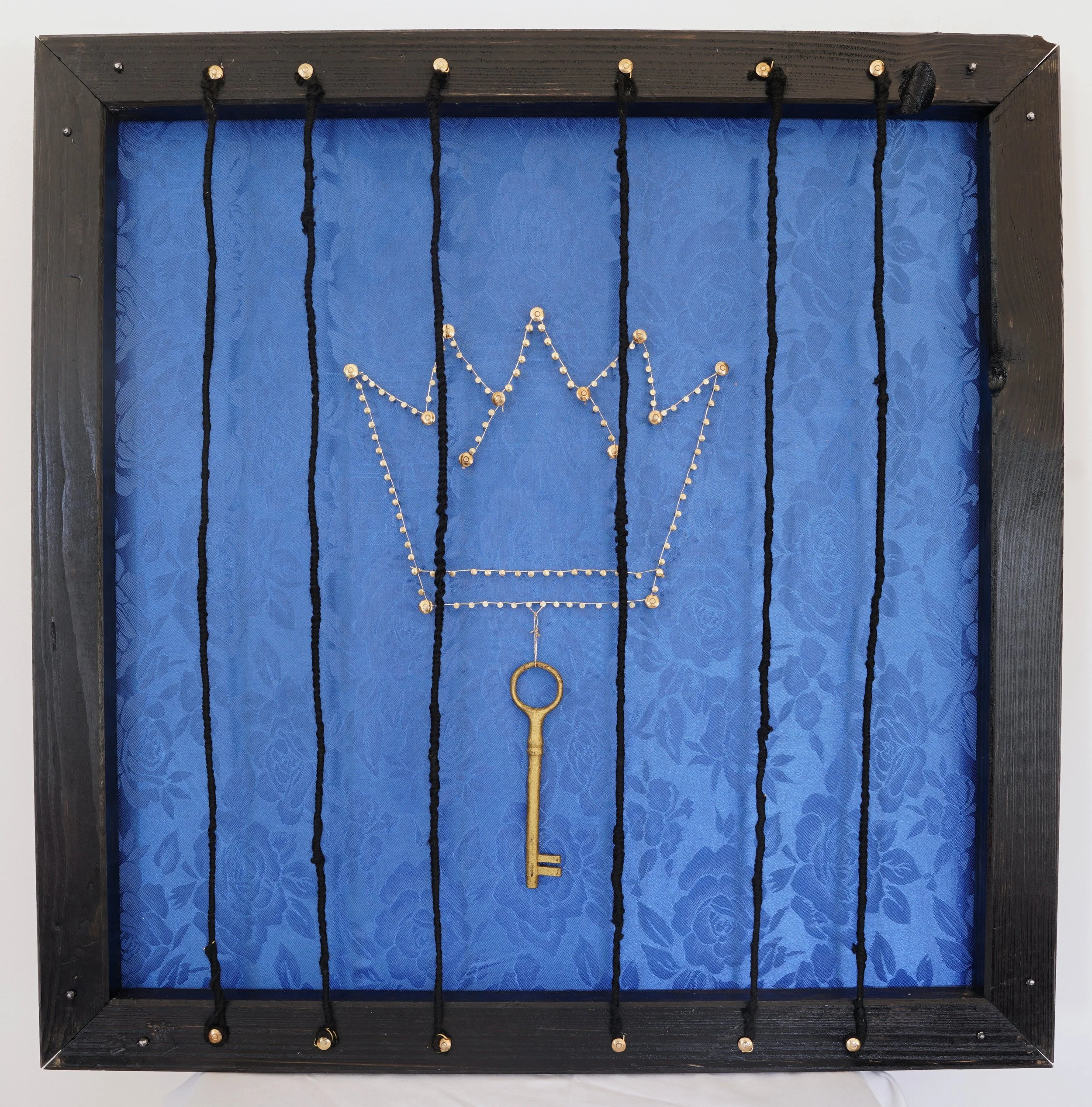
HOLLOW CROWN: The appearance of power
HOLLOW CROWN is a symbolic artwork I created to explore the difference between looking powerful and possessing power.
The crown is one of the most recognisable symbols of authority, status and achievement. We associate it with importance, recognition and having reached a position of influence. However, I wanted to examine what happens when we become more invested in the appearance of power than in what actually gives us power.
Its hollow centre represents how an impressive exterior can conceal an absence of substance. We can build identities around titles, recognition, expectations and other people's definitions of success until we become more attached to the image than to what genuinely belongs to us.
For me, the hollow crown is not necessarily about having no power. It is about mistaking the symbols of power for the thing itself.
This also extends to the identities we inherit, the expectations we accept and the standards we adopt without questioning where they originated. We can spend years building ourselves around ideas that came from somewhere else, eventually accepting them as our own.
When you build your identity around somebody else's success, you can become very good at looking the part while losing touch with what makes you distinct.
The work asks a question: are you wearing the crown because you know your power, or because you need other people to believe you have it?
And if you take away the title, the status and the recognition, what remains?
The crown is not the power
There is nothing wrong with wanting recognition, building a successful business, presenting your work professionally or learning from people who have achieved what you want. The difficulty begins when the appearance of success becomes more important than the work itself, and somebody else's definition of achievement starts determining your decisions.
You can build an impressive brand and still feel disconnected from what it represents. You can have the audience, the recognition and the appearance of authority without feeling that you own the direction you have taken.
Before changing everything again, examine what you have already built. Look at the decisions behind it, the patterns running through it and the things you may have abandoned along the way.
You do not need another person's crown. You need to understand what you are building, what holds it together and why you have made the decisions that brought you here.
THE THINKING
THE THINKING is an independent examination of existing creative work, projects, businesses and consequential decisions.
I examine the underlying patterns, strengths, tensions, contradictions and unanswered questions within what you have built. The purpose is to help you see what is happening, understand what may be influencing your decisions and determine what deserves your attention next.
If you have built something substantial but feel disconnected from its direction, it may be time to examine what is already there.
Bring me the decision you are too close to see.
